


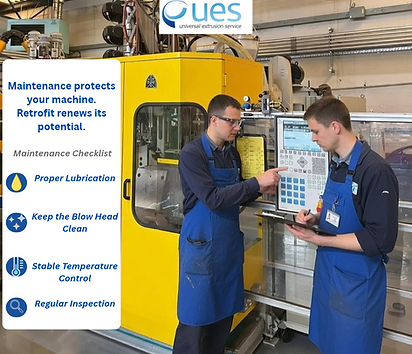
Extending the Life of Your Blow Molding Machine Isn’t Luck — It’s Strategy
4 maintenance practices that can protect performance, reduce downtime and extend machine life.
How systematic maintenance, early fault detection and process monitoring can help manufacturers protect equipment reliability and production performance.
How long should a blow molding machine last?
There is no single answer.
Machine age, operating conditions, production hours, materials, process parameters and maintenance practices all play a role. But one thing is certain: a machine does not have to be “old” to become inefficient — and a well-maintained machine can remain productive for many years.
The difference often comes down to strategy.
Many maintenance problems do not begin with a major breakdown. They begin with small changes that gradually go unnoticed: a lubrication point that is neglected, material build-up around the blow head, temperature fluctuations, a sensor that becomes less reliable, or a component that is inspected only after it fails.
These may seem like minor issues.
Over time, they can become expensive ones.
Small actions → big savings.
That is why extending machine life is not simply about repairing equipment when something goes wrong. It is about maintaining the machine systematically, identifying early warning signs and preventing unnecessary wear wherever possible.
Here are four areas that deserve particular attention.
01 — Proper Lubrication
Lubrication is one of the simplest maintenance tasks — and one of the easiest to underestimate.
Moving components operate under friction, load and repeated movement. Without the right lubrication strategy, wear can increase and component life can be reduced.
But proper lubrication is not simply a matter of adding lubricant.
It means using:
-
The correct lubricant
-
The correct quantity
-
The correct lubrication points
-
The correct maintenance intervals
-
Clean and accessible lubrication points.
Over-lubrication can be just as undesirable as insufficient lubrication, which is why lubrication procedures should follow the machine manufacturer's recommendations and the actual operating conditions.
The objective is simple:
Reduce friction. Control wear. Protect critical components.
A relatively small and predictable maintenance activity can help avoid much larger repair costs later.
02 — Keep the Blow Head Clean
In blow molding, process stability depends on much more than mechanical condition.
The blow head and surrounding process area require particular attention because material build-up, contamination or residue can affect process consistency and product quality.
Depending on the machine and application, insufficient cleaning can contribute to issues such as:
-
Inconsistent material flow
-
Uneven wall thickness
-
Surface defects
-
Process instability
-
Increased scrap
A clean blow head also makes it easier for maintenance and production teams to identify abnormalities early.
This is an important point:
Cleaning is not only about appearance. It is part of process control.
Regular cleaning and inspection can help prevent small process deviations from developing into larger quality or maintenance problems.
03 — Maintain Stable Temperature Control
Temperature control is another area where small deviations can have a noticeable impact.
Blow molding processes depend on consistent and repeatable thermal conditions. When temperatures become unstable, the effect may first appear as a process or quality issue rather than a machine problem.
Typical warning signs include:
-
Temperature fluctuations
-
Slow heating or cooling response
-
Inconsistent temperature readings
-
Aging heaters
-
Faulty or drifting sensors
-
Unreliable temperature controllers
Stable temperature control supports stable processing.
And stable processing helps reduce unnecessary variation and stress throughout the production process.
Think of it as a chain:
Stable temperature → stable process → consistent production
When temperature control becomes less reliable, investigating the underlying cause early can help prevent recurring quality problems and unnecessary production losses.
04 — Regular Inspections
The most effective maintenance strategy is rarely based on waiting for something to fail.
Regular inspections create an opportunity to identify changes before they become failures.
A practical inspection routine should consider the major systems of the machine:
-
Mechanical
Check for unusual vibration, wear, loosened connections and changes in component movement.
-
Hydraulic
Look for leaks, pressure changes, damaged hoses, worn seals and irregular movement.
-
Electrical & Controls
Inspect sensors, wiring, connectors, control components and recurring fault messages.
-
Process Performance.
Monitor cycle time, scrap rate, temperature stability and other changes in production behavior.
This is also where the warning signs from our previous series become particularly relevant.
A machine may still be running, but changes in vibration, hydraulic performance, cycle time, scrap rate or electrical behavior can provide valuable information about its condition.
The earlier these changes are identified, the more options you typically have.
The Cost of Neglect
Preventive maintenance is sometimes viewed as an additional operating cost.
Reactive maintenance can be much more expensive.
When a problem is addressed only after failure, the consequences may include:
Unplanned downtime
Production stops when you least expect it.
Emergency repairs
Decisions have to be made quickly, often with limited options.
Higher scrap
Process instability can continue until the root cause is identified.
Secondary damage
A small component issue can place additional stress on other parts of the machine.
Lost production capacity
The true cost of downtime can extend far beyond the repair itself.
This is why maintenance should not be measured only by the cost of the maintenance activity.
It should also be measured by what that activity helps prevent.
The cheapest repair is often the one you never have to make.
Think Beyond “Does the Machine Still Run?”
One of the most important changes in maintenance thinking is changing the question.
Instead of asking:
“Is the machine still running?”
ask:
“Is the machine running efficiently, consistently and reliably?”
A machine can continue producing while becoming slower, less stable, more maintenance-intensive or more expensive to operate.
That is why machine condition should be evaluated not only by whether it is operational, but also by its performance, repeatability and reliability.
Regular maintenance and inspection can help extend component life and provide valuable information about when modernization, refurbishment or a more comprehensive overhaul should be considered.
A Simple Maintenance Mindset
Use this checklist as a starting point:
☐ Lubrication points are checked regularly
☐ The blow head is kept clean and inspected
☐ Temperature control remains stable
☐ Mechanical and hydraulic systems are inspected
☐ Electrical components and sensors are checked
☐ Changes in cycle time and scrap are monitored
☐ Recurring faults are investigated rather than simply reset
The goal is not to eliminate every problem.
The goal is to identify problems early, understand their causes and act before they become costly.
Final Thought
Extending the life of a blow molding machine is not about keeping an aging machine running at any cost.
It is about making informed maintenance decisions that protect reliability, productivity, product quality and the value of your equipment.
Machine life isn’t luck. It’s strategy.
Small maintenance actions, performed consistently, can make a significant difference over the long term.
At UES we help manufacturers keep their blow molding equipment reliable, efficient and ready for production — from inspections and maintenance to modernization and overhaul solutions.
Is your maintenance strategy focused on preventing failure — or reacting to it?